

Last week, on the TV show, Insight, the topic was “Discovering a Hidden Past.” The key questions addressed were: Should discovering a loved one’s buried past impact your present-day relationships? And how does it shape who you are? Audience members revealed a wide variety of uncovered secrets, but unfortunately, Insight didn’t address the issue of whether it’s okay for a closeted LGBT person to hide their identity from their straight husband or wife. And how does the straight spouse make sense of the marriage after discovering their partner’s secret?
When a straight spouse discovers the truth about their partner’s secret sexual orientation or gender identity, it’s more than just discovering a hidden past. It’s discovering a secret that exists in perpetuity. It doesn’t just go away. The past that was hidden has continued to be hidden from the person who was impacted the most by the secret.
Before delving further into the issue of secrets in closeted mixed-orientation marriages, let’s look at some points made during the Insight episode.
Insight: Discovering a Hidden Past
The Insight interviewer, Kumi Taguchi, talked to a number of audience members who’ve been affected by the discovery of a family member’s secret. Secrets such as:
- A father’s previous wife and child in another country
- A mother’s cause of death was suicide due to post-natal depression
- A father who was in jail for murder, not “away working”
- A recently deceased husband who had killed his first wife
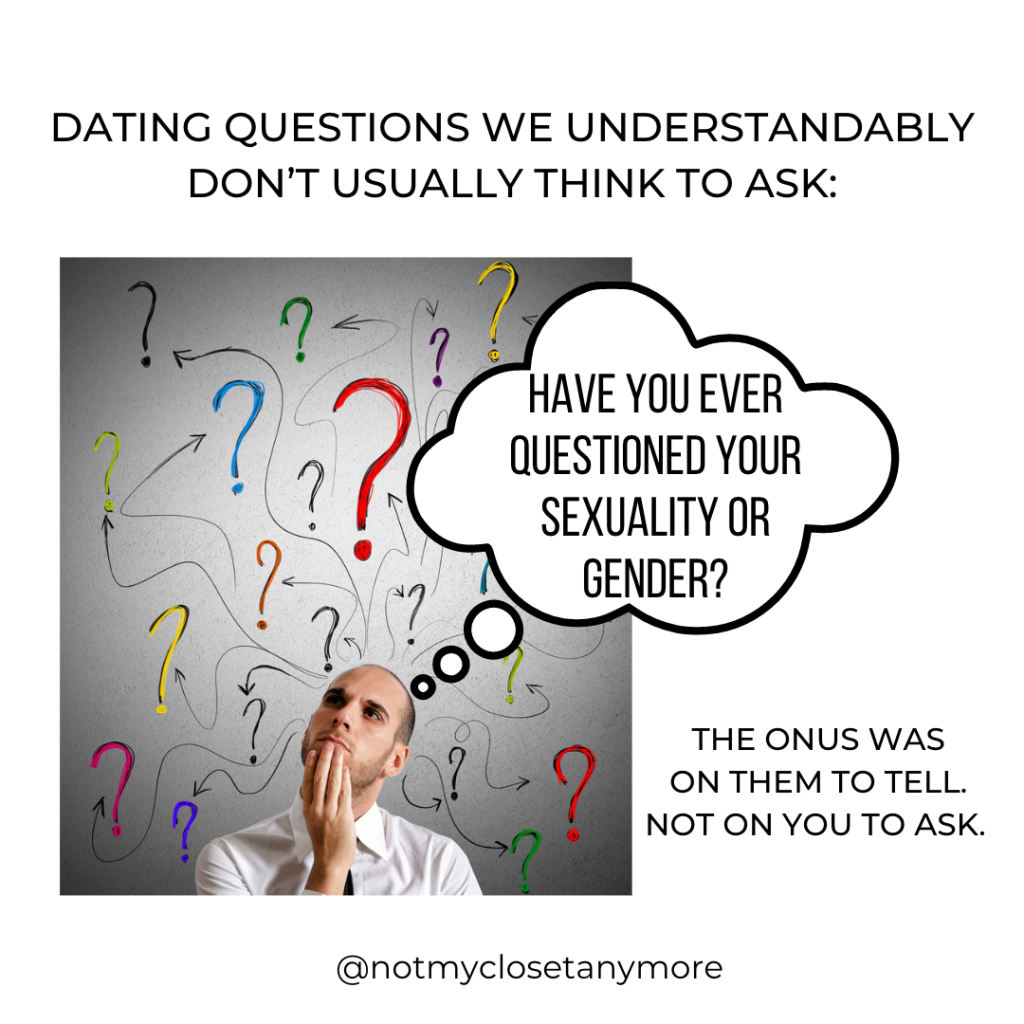
One audience member said that his father hadn’t revealed the truth about his past because the son hadn’t directly asked them about it. In response to Taguchi’s question about whether the onus was on him to ask the question, the son answered, “You don’t know what you don’t know. There are an infinite number of possible questions you might never even think to ask someone.”
Some of the comments made during the episode by people who’ve discovered a family secret include:
- “I definitely think it’s beneficial to disclose the truth about the past, especially if it affects (the other person)”
- “If (my partner) had hidden her family history from me and only told me much later in the relationship, I would feel betrayed”
- “It’s about being honest because we are family, and there should be nothing to hide”
- “Why didn’t I know about this until now?”
Is non-disclosure the same as a lie?
Kaguchi attempted to differentiate between deception and simply “not telling”. Is it okay to keep something from the past hidden from your family? The difference primarily seems to come down to the reason for withholding the truth. If the secret-keeping is to advance the secret-keeper’s own purpose and to benefit or protect themselves, it is deception.
Karen Jones, from the University of Melbourne, a philosopher who studies trust in relationships, agreed, stating: “Lies are almost invariably violations of trust. (In contrast), not revealing something is only sometimes a violation of trust. But when not revealing something IS a violation of trust, it could be morally equivalent to lying. It could, in fact, be worse than a lie.”
I firmly believe that non-disclosure of a closeted LGBT person’s sexuality or gender orientation is a violation of the straight partner’s trust. More about that to come… First, let’s look at another issue addressed on Insight.
Does uncovering a secret about our partner impact how we see ourselves?
Self-identity doesn’t form in a vacuum. In addition to our internal experience, we get a sense of ourselves in our relationships with others. They hold a mirror up to us, and we see ourselves through their eyes. When a person is withholding a significant secret, particularly one about who they are, it sends a warped message to others that later needs to be recalibrated once the truth is discovered.
Taguchi asked Karen Jones, “When we uncover something in a family member’s past, can it impact how we view ourselves?” Karen’s response is worth sharing in its entirety:
“I think it can change our self-conception, which is important for how you encounter the world, how you understand who you are and what your values are. Through a normal course of life, our self-conceptions change, but when you’re abruptly given this new, potentially important, sometimes even traumatic piece of information, you can get an abrupt discontinuity between self-conception. You can feel unmoored, adrift… Who am I? How do I process this? What should I do next? Has some part of my life (perhaps a large part) perhaps not had the meaning that I thought it had? Those are profound experiences of confusion and bewilderment.”
Susan, who discovered that her husband had killed his first wife, said in a Mamamia interview that he “took away (her) right and agency to make an informed decision about (her) future.” It “stripped away her sense of being loved.” (This is an experience most straight spouses will relate to!) Susan wrote about her horrific experience and the lies people tell to safeguard their own happiness in her book, The Love That Remains*.
As a straight spouse, you were thrown into a state of cognitive dissonance after discovering your partner’s secret. Finding yourself in a closeted mixed-orientation marriage can have a significant impact on your sense of self. It’s not only a case of, “Who is this person I married?” But also, who am I? And how did I end up here? Am I still a wife? Was the whole marriage a ruse? What does that say about me?
The right to keep a secret versus the right to know
“To a certain extent, I do think we have a right to keep our past to ourselves. However, when it affects somebody else’s sense of who they are, and it affects somebody else’s sense of their trust in you, then I think it needs to be shared” (Susan).
There’s a significant difference between something that’s private and something secret. A personal matter that doesn’t affect anyone else may understandably be kept private. It has little to no impact on someone else. In contrast, intimate secrets within an intimate relationship are divisive and destroy intimacy, particularly when they’re used to protect the secret-keeper.
After the shock of discovering your partner’s secret sexual orientation or gender identity, it takes time to recalibrate and find solid ground again. If you need help to find your footing, I’m here to help.
*Affiliate link


Hi Karen
Thank you for this article. So helpful . It takes so long to come to terms with it all. We kept going for 4 yrs after disclosure , but the whole experience was soul destroying. Piecing my life together and getting on now .
Excellent article Karen! You give a rational and compassionate voice to the straight spouse experience.
Thank you Lisa
Thanks Karen, so frustrating that Insight didn’t include a Str8 spouse story
Yes, frustrating, and yet unsurprising sadly.
You have a way of helping us understand and process the depth of the pain caused by our closeted spouse. Thanks for giving us a voice and for helping us heal.
Thanks for your comment and kind words, Laura. I’ve lived through it and I help others through it, and I’m so pleased that you’re finding the writing here helpful.