
Much has been said about harm that conversion practices cause to gay people. Far less has been said about the collateral damage of conversion practices on the women married to men struggling with same-sex attraction or hidden gender identity. My primary purpose of writing this article is to draw our attention to the ways in which straight wives have been impacted by a problem that was never theirs.
While watching ABC’s Compass episode, Reclaiming Pride, this week, I found myself thinking about the parts of the story that people often overlook. Although the episode centres, understandably, on one survivor’s journey and advocacy, I acknowledge that it also briefly addresses the impact on his former wife. This is good to see, although it only scratches the surface of a largely unexamined terrain of relational harm.
Firstly, what are conversion practices?
Historically, religious ideals and social acceptability standards have influenced expectations around heterosexual marriage and family life. A failure to fit in with these norms could lead to criminal conviction, public shaming, and inner turmoil. People attracted to the same sex, or identifying as a different gender, would often suppress the truth about themselves to meet societal expectations. In many cases, the person was grappling with unwanted same-sex attraction and desperately seeking to change this aspect of themselves. Unfortunately, marrying a straight partner was frequently part of the solution.
Sometimes referred to as “conversion therapy” or “reparative therapy”, conversion practices are based on the belief that sexual orientation, gender identity, or gender expression can, and should, be changed or suppressed. People are led to believe they are broken or disordered, and to resist or override their unwanted same-sex attraction. While religious institutions have often driven these practices, family expectations, cultural norms, heteronormativity, and rigid gender roles also play a significant role. Many states in Australia have now passed laws to criminalise conversion practices.
To understand conversion practices, we need to look at the religious context that has shaped and sustained them. We also need to increase our understanding of the impact on straight partners.
The religious context of conversion practices
To understand the context in which conversion practices developed, it’s important to acknowledge the genuine struggle many religious communities have faced in trying to reconcile long‑held beliefs about sexuality with shifting social norms and growing legal and ethical scrutiny. Within this tension, religious institutions shaped and sustained conversion practices while grappling with questions of morality, sexuality, and human worth.
The theological spectrum: from suppression to affirmation
At one end of the theological spectrum, homosexuality is framed as sin, with faithfulness understood as resistance, avoidance, or eradication. At the other end are theological reconstructions that re‑examine inherited beliefs, arriving at positions of acceptance or affirmation of same‑sex identity. Books such as God and the Gay Christian reflect this latter approach, arguing that faith and homosexuality are not inherently incompatible.
Between these poles, many churches adopted a middle position often summarised as “love the sinner, hate the sin.” This stance sought to preserve doctrinal beliefs while maintaining relational inclusion, typically by drawing a distinction between identity and behaviour.
It is within this middle terrain that conversion practices often became covert rather than overt. Without formal programs or therapies, people struggling with same‑sex attraction might still receive subtle, persistent messages that greater faithfulness required control, suppression, or redirection of desire. In some contexts, marriage to a person of the opposite sex was encouraged as a tangible expression of faithfulness — and, at times, as a way to manage or negate perceived sinful desire.
Sometimes the suggested solution was to marry a woman. The underlying message was: You can pray the gay away, and perhaps even MARRY the gay away.
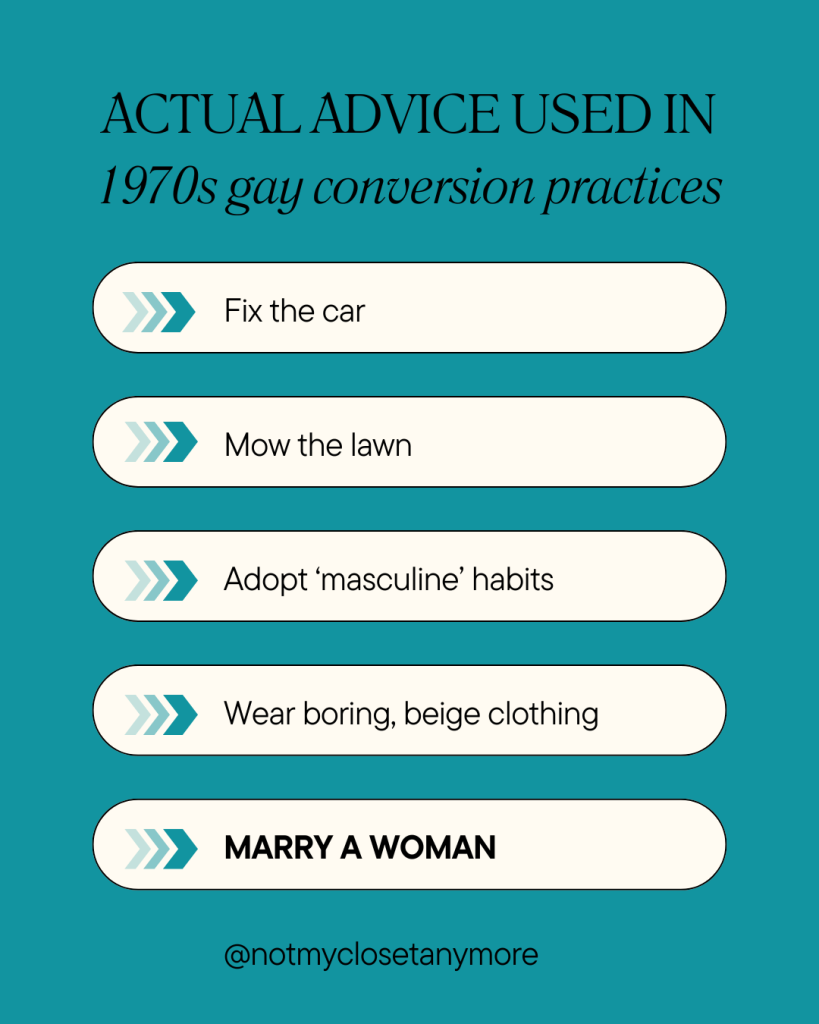
When heterosexual marriage is offered up as God’s provision or solution, straight spouses are drawn into a spiritual strategy they did not author. The relationship becomes a testimony or proof that “sexual sin” has been overcome, rather than one entered on equal, informed terms.
The straight partner is not seen primarily as a person to be known and cherished, but as evidence that their partner has overcome their homosexual desires. This is objectification, and it carries a relational cost that is rarely acknowledged as spiritual harm. Yet that is precisely what it is: religious trauma enacted in the name of spiritual discipline.
How conversion practices cause harm
Conversion practices were founded on the belief that something was fundamentally wrong with people who experienced same‑sex attraction or gender diversity. And many believe it to be true about themselves. They genuinely grapple with desperately unwanted same-sex attraction. For decades, these practices inflicted profound psychological harm on many people, embedding shame, self‑hatred, fear, and confusion, and encouraging deep mistrust of one’s own inner life.
Religious leaders often taught that prayer, discipline, denial, or heterosexual marriage could undo a person’s sexuality. Consequences often included: dissociation from the body, fractured identity, chronic anxiety, depression, and long‑term trauma. Living as a gay person came to be understood as a moral failure to overcome sinful desires.
The criminalisation of conversion practices in some jurisdictions represents an important recognition of this harm, while also causing an ethical dilemma for some religious groups. Coercing a person to deny who they are is not without consequences
How conversion practices harm straight spouses
It’s time we acknowledge the harm done to straight spouses when marriage is used as a conversion practice, to resolve unwanted same‑sex attraction and as “proof” of success. In this dynamic, the spouse is not only affected by the process; she is integral to it, positioned as both the instrument and collateral damage.
Within this framework, wives don’t enter a mutual relationship on equal or informed terms. They enter a system that assigns them a function. They are not invited as partners in a shared life, but positioned as solutions to a problem that was never theirs to resolve. Their lives, bodies, emotional labour, futures, and sense of self are leveraged in the hope that someone else’s inner conflict can be managed, suppressed, or erased.
A wife becomes visible proof:
- proof of straightness
- proof of moral success
- proof that suppression can work
This is where the harm becomes unmistakable. When belief systems enlist a human being to address “unwanted gayness,” and then hold her up as evidence that the problem has disappeared, they reduce a partner to a role rather than honour her as a person. She exists not as a collaborator in a shared life, but in service of an outcome shaped by religion, culture, and fear.
“I felt like a service provider. I felt emotionally abused.” Julie
For women inside these marriages, the cost of carrying someone else’s unresolved struggle is profound. Day after day, the relationship quietly erodes her sense of agency and dignity.
Wives who knew
Some women enter these marriages aware that their partner experiences same‑sex attraction. Often, they share the religious belief that desire can be redirected, overcome, or disciplined through faith and commitment. In contexts shaped by purity culture, sexual inexperience can leave women particularly vulnerable to these relationships.
Julie recalls, “A few weeks before we married, Andrew (not his real name) said he was worried about having sex. He let me believe it was because he was a virgin. Later, after leaving me for his boyfriend, he admitted he had been worried about having sex with a woman.”
Religious expectations and spiritual coercion can harm both partners. Julie says Andrew asked her to marry him just a month into their relationship. “He hadn’t said he loved me, and he told me not to tell anyone he was gay. I think he asked me to marry him to ‘lock it in.’”
Within this broader pattern, the wife’s experience often follows a familiar path. She adapts herself to the relationship and to the belief system that surrounds it, learning to prioritise sacrifice, endurance, and loyalty over her own needs. Over time, living within a low‑ or no‑passion marriage, her self-worth dissipates.
She, too, is a survivor of conversion culture.
Complying with religious frameworks that normalise self‑denial and obedience, she is often expected to carry the emotional and spiritual weight of her husband’s struggle. The legacy of this coercion can take the form of religious trauma; not dramatic or explosive, but slow, internalised, and deeply wounding.
Knowing about her husband’s same‑sex attraction does not protect her from harm. She may spend years, or even decades, in a relationship marked by emotional distance, the absence of genuine sexual intimacy, and the quiet grief of being undesired or only conditionally desired. If the marriage ends, narratives of his liberation and pride often eclipse her loss. If it endures, she may remain trapped in dynamics of coercive control, her life structured around spiritually acceptable roles and distractions.
With hindsight, she may blame herself for believing the marriage could be fulfilling – that it would “work”. Shame settles in, further eroding confidence and hope. Julie reflects, “I became a shell of myself and lost hope.”
This is not an anomaly, but a recurring outcome of conversion practices that position women not as partners in a shared life, but as solutions to someone else’s inner conflict.
Wives who didn’t know
For other women, there is a complete absence of informed consent. She enters marriage believing her husband fully desires her and shares her commitment to building a life together. Only later does she discover that he had been suppressing a core part of himself, or quietly acting on it in secret. In these marriages, the wife’s experience often follows a stark and devastating trajectory. She did not consent to being part of a conversion process, nor did she knowingly enter a mixed‑orientation relationship. The marriage was naturally understood by her to be a conventional heterosexual union. She believed she was chosen freely and fully, desired and loved as promised.
The revelation that her husband harboured sexual desire for men, or had been acting on that desire outside the marriage, constitutes profound relational trauma. It fractures trust, destabilises identity, and shatters the shared reality on which the relationship was built. She must completely reconstruct years of memory and meaning through an unwanted lens.
Years of shared history suddenly collapse.
In the aftermath, she often spirals into shame, faulting herself for not recognising what others, armed with hindsight and distance, later insist was “hidden in plain sight.”
Betrayal in this context is sexual deception and false intimacy. She gave her body, her trust, and her commitment under false premises. Without access to the truth, genuine consent was impossible. From the start, the foundation of the relationship was compromised. What often follows is not only grief, but disorientation. Others may ask her, implicitly or explicitly, to reconcile her devastation with narratives of his authenticity, courage, and liberation, or to recast him as the ultimate victim while diminishing her own experience. In doing so, they bypass her pain entirely and reduce it to collateral damage in someone else’s self‑realisation.
This harm deserves naming.
Different paths, enduring harm
Marriages formed under conversion ideology often unfold in different ways, though the underlying harm to straight spouses remains enduring.
- Some end abruptly, when the husband leaves the marriage in a rapid and public embrace of authenticity, sometimes without the capacity to attend to the devastation left behind.
- Others persist for years, marked by emotional withdrawal, resentment, or patterns of harm that intensify as suppression takes its toll.
- Some involve parallel or secret sexual lives conducted alongside the marriage, compounding the rupture of trust when discovered.
Across these divergent paths, a common expectation often emerges: once her role as the “solution” is no longer required, the straight spouse is expected to fade quietly from the story.
When trauma is passed on
It is both important and uncomfortable to acknowledge that experiencing systemic harm does not automatically prevent a person from causing harm to others. Many gay men subjected to conversion practices were deeply traumatised. In some cases, that unresolved trauma was displaced into their closest relationships through emotional withdrawal, contempt, scapegoating, or patterns of coercive behaviour, particularly within marriages formed under pressure to suppress identity.
Naming this complexity is not homophobia. It is an honest recognition of how unaddressed trauma can reverberate relationally.
We do not honour trauma by pretending it is harmless to others.
Why naming this matters
Acknowledging the harm done to straight spouses does not diminish the suffering of gay people under conversion practices. It simply refuses the idea that compassion must be rationed.
An ethical response to the legacy of conversion practices requires recognising the full spectrum of harm they produced, both personal, relational, and spiritual.
- No one should be conscripted, knowingly or unknowingly, into another person’s identity struggle.
- No one’s life should function as a therapeutic intervention.
- No one should be treated as evidence rather than as a person.
Holding the whole truth of conversion practices
As stories of conversion practices surface more openly in the mainstream, we have an opportunity to tell the whole truth. These are not only stories of individual liberation but also of the relational costs borne by straight partners.
Straight spouses are not footnotes to this history. They were part of the architecture that allowed conversion practices to appear viable, faithful, or successful.
Until their experiences are acknowledged, the reckoning remains incomplete.
Moving forward from harm
If conversion practices or secrecy have caused harm in your relationship, you deserve care and understanding. You may have pastoral support that is validating and empathic in helping you deconstruct your beliefs around this issue. Or perhaps there’s a family member or close friend who understands and validates your experience. Alternatively, if you’d like to explore therapy or coaching with me, you’re welcome to reach out. You may also like to sign up for Letters From a Straight Spouse, as I’ll be re-releasing a major faith survey in the coming months.
You don’t have to carry this alone.

I was one of the wives “who didn’t know.” After divorce, he shared with our son that he married me because he wanted marriage and children and believed I would be a good mother . . . making me feel as a piece of meat. We had been high school sweethearts. I had believed I had a fairytale marriage, only to find it was a figment of my imagination.
Now, I have three children who praise their father and stand by him in all he does, including his gay marriage to another man, and continually criticize me for being the one to break up our ‘happy family’ and wonder why I hold onto the bitterness. I truly am not bitter. I have forgiven him, but at the same time bear the brunt of their hurtful words and attitudes toward me. I understand they are collateral damage, as well.
I wrote a book, Not My Shame, under my maiden name, Sheila R. Boyd, available on Amazon. It is a biographical approach to the terrible wound inflicted on myself by his self-denial and life of deception. Several other straight spouses have shared with me that it gave them strength to navigate this road.
Thanks for making your writing available. It sheds light on the inherent discrepancy between what these relationships show the world, and what is actually taking place. My mother was the “straight spouse” and Dad was and still is closeted. I struggle to “unlearn” the emotional dynamic that was presented as normal and healthy by my parents, In many ways it was an emotional template for my own adult partnerships with emotionally unavailable men who were not transparent about their own lives. I am in therapy for my own issues, but reading anything about mixed-orientation marriages zeroes in on un-named, yet damaging issues that were present in my family of origin. I am a part-time caregiver for my closeted parent, so the “unreality” of his universe continues into the present. Your writing, and the concept of compassion for both spouses is very, very helpful to me.
As always Karen, you have managed to put into words the emotion, the fear, the trauma and the experience that is so close to home for many. I feel like my husband did his own type of ‘conversion therapy’ after being raised in a very, very religious home and experimenting with men before I came along. I feel like he decided to ‘marry the gay away’ but to also get the marriage and family that he wanted. After decades of his infidelity and only recently being discovered, I am only just beginning to learn about the impacts that the religious upbringing had for his identity. Now, I’m left to put myself back together and face the stark reality of being collateral damage. When he tried to ‘marry the gay away’, he systemically eroded my soul without my knowledge or consent. Thank you for being our advocate and for being the voice that I can’t use myself, due to currently still being trapped in his closet.