
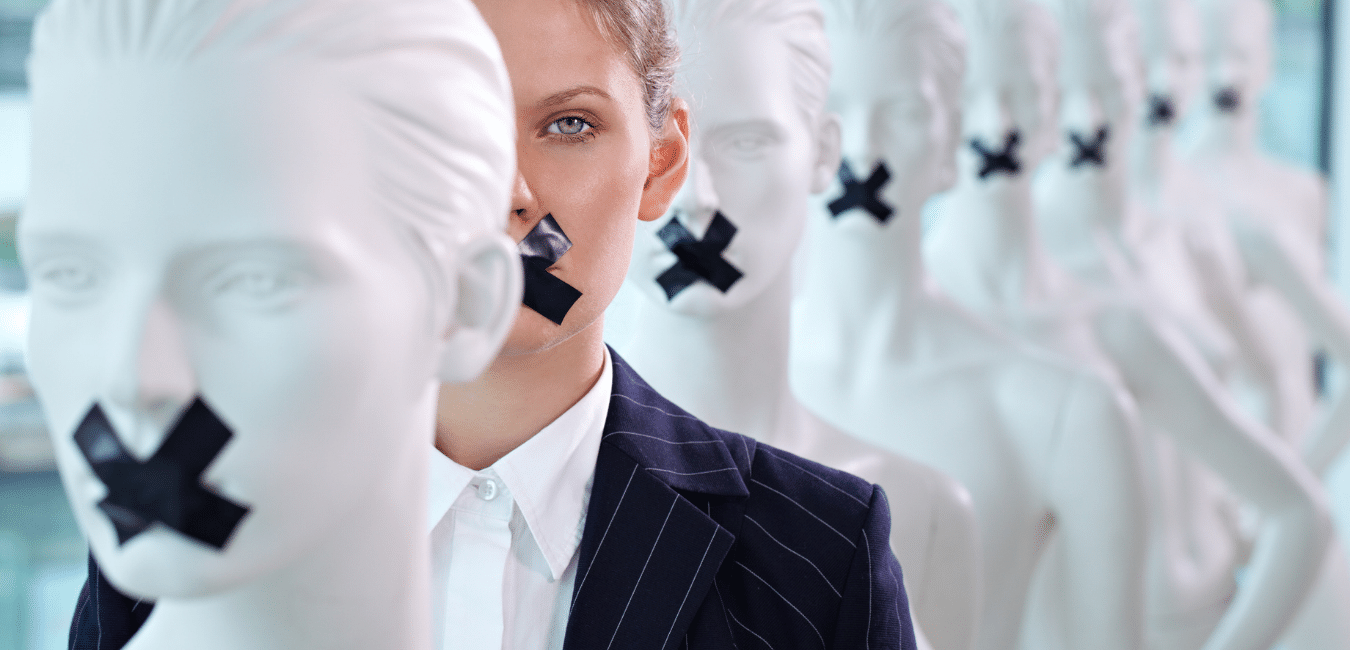
We all have stories to tell. True stories about our lives. There is something incredibly validating about having our stories heard and validated. Unfortunately, straight spouses and partners of trans people are often silenced after discovering their partner is LGBTQIA+, because their story naturally includes the story of someone who was closeted, which can have unintended ramifications. It is also a story many do not want to hear. The sound of silence reverberates in an echo chamber of those who don’t want to hear straight spouse stories. The silencing of straight spouses and partners of trans people has a detrimental impact on men and women who have suffered relational trauma.
The Silencing of Straight Spouses and Partners of Trans People
The power of speaking the truth is often stripped away when someone finds themselves in a closeted mixed-orientation relationship, after discovering that their partner is not who they thought they were. Straight partners and partners of trans people** in a relationship with a closeted LGBT person are too often silenced. Their stories don’t sit comfortably with many people today.
When straight partners have been hurt by their lesbian, gay, bisexual or transgender partner’s secrecy, speaking about this is often interpreted as homophobic or transphobic. The assumption is that straight partners don’t have a right to talk about their suffering because, in doing so, they are speaking negatively about a person from a minority who has so often been harmed and silenced themselves. So their voices are silenced.
If the straight partner tells their story, they are also inadvertently telling the story of their closeted gay or transgendered partner or ex-partner. If the LGBT partner is unwilling (or feels unable) to “come out of the closet”, the straight partner has two options:
- Silence themselves or
- “Out” their partner
LGBT closets are places of shame, secrets and silence, so it’s a complex situation when one partner wants to come out of the closet and the other does not. The intersectionality of the straight partner’s right to speak and the closeted partner’s preference to stay closeted is an ethical dilemma.
Is it ok for straight partners to speak of their experience if the closeted partner stays closeted?
Realistically, no one has a right to force someone to stay silent about something that has directly happened to them. Although closeted LGBTQIA+ partners usually have a right to keep their sexual orientation private, it gets tricky when they married a straight, non-trans partner without giving them the right to make an informed choice. Telling the straight partner that they can’t talk about what’s happened to them protects the privacy of the closeted partner, but forces the straight partner to keep a secret that was never theirs to keep. It cuts them off from essential support. This is an ethical dilemma that would even be difficult for Chidi to solve in the brilliant TV series, The Good Place.
When the closeted partner doesn’t feel ready to tell their story, straight partners often feel significantly conflicted about whether they can tell their own. The potential ramifications of telling the truth causes many straight partners to remain silenced.
Take a moment to listen to this haunting, powerful rendition of “The Sound of Silence” by Disturbed:
Silenced by Society
Unfortunately, when straight partners talk about what happened to them, it is often met with minimisation instead of validation, and shaming instead of support. The same society that once shamed (and often still shames) LGBT people now often silences and shames their straight partners.
People may not know how to integrate acceptance of lesbian, gay, bisexual and transgender minorities, with an acknowledgement that an LGBT person has caused harm. The assumption is often made that validating the suffering of the straight partner is homophobic or transphobic. Some people find it difficult to show empathy and compassion for both sides.
Here are some examples of comments said to straight partners that have effectively silenced them:
- “Why can’t you be happy for him/her/them?”
- “You should celebrate their truth!”
- “How dare you say they did a bad thing!”
- ”How wonderful he feels safe today to be authentic! Aren’t you proud of him?”
Here are some ways straight partners have described their experience of being silenced:
- “I held back in order to avoid putting friends in an awkward situation. Often these same people knew the script for supporting my gay ex wife, and the result was a feeling she had an audience when I did not…even when the people in question wanted to support both of us.”
- “It often felt like my pain was invisible when everyone was congratulating and praising my trans ex for coming out.”
- “I was told not to tell anyone. He doesn’t want our grown kids to know, as he’s afraid they will tell their friends or post on social media. He has a boyfriend now.”
Straight partners are often told that the problem is “nothing to do with their partner being gay, bisexual or trans,” but to them it is deeply interwoven, because the sexual orientation or gender identity is such an intrinsic part of who their partner is. It was the reason for the lie and for the ‘closet’.
For straight partners, it is often considered unacceptable to speak of the harm they have experienced in their relationship with a closeted partner.
This is a story I know too well. But it is one I could not speak of for quite some time.
Silenced by a Closeted Partner’s Shame
I will share a little of my story as a way of “un-silencing myself” and hopefully encouraging you…
After 24 years of marriage, I discovered the secret my husband had been keeping in the dark. He had sadly felt unable to be himself or live an authentic life, and so he hid both of us in his closet of shame. He had hoped desperately that by marrying a girl he liked, that the “gay would go away”, and he could live the hetero-normative life he thought he wanted. A life of acceptance and acceptability. I empathise with the shame he felt, but it wasn’t okay to marry me without telling me the truth.
I was sworn to secrecy. He was unwilling to ‘uncloset’ himself as he grappled with his inner turmoil and shame (and I didn’t know if it would ever change), and so I entered a cone of silence and social isolation that felt completely unbearable. My isolation was exacerbated by geographical distance, as we had moved 1000km interstate about 2 weeks after he’d finally told me the truth. I was traumatised and grieving, living far from friends and family who knew me but didn’t know what I was going through. I couldn’t lie to them, but I wasn’t ‘allowed’ to tell the truth, and so I limited my contact with my former friends. This had a significant impact on those relationships, which had been previously very close.
Unable to speak of my situation, I suffered in silence. It was dark, scary, lonely, and incredibly isolating.
After 15 months, my husband agreed to tell our children, and he wisely didn’t expect them to keep it a secret, so he starting coming out more publicly. And I was finally free to tell, too. In theory. I still remember the first time I said the words out loud:
My husband is gay.
It was my GP that I told. The words, which had been bottled up for too long, burst forth with a torrent of tears. I finally had a voice, but with others it started as a whisper, told with quivering lips. I still felt cautious, because by talking about what happened to me, I was talking about him, too. And that felt… complex.
Silenced by the Past
I was always the “good girl” growing up.
I was taught not to “speak back” to your parents.
I complied.
I was class captain, house captain, and school captain.
I was the good girl who didn’t get blind drunk at parties.
I travelled overseas to do mission work.
I went to church, said my prayers, and tried to do the right thing.
I was a good wife.
And that looked like compliance and silence.
“Good wives don’t speak ill of their husbands.”
“Good wives don’t get divorced.”
Speaking about what had happened felt… disloyal.
But over time, it became harder to stay silent.
Beginning to Speak
When we told the children, I had let him take the floor and control the narrative. It felt like it was his story to tell, but I regret that, as it was my story, too. They mostly heard about how hard it had been for him to keep the secret.
He spoke.
And I felt silenced.
Gradually, I began opening up to friends and family, although my ‘good girl’ usually had the upper hand, speaking words that were “nicer” and more censored than they perhaps needed to be. There was a part of me that wanted to shout it from the rooftops to anyone in earshot. There was a part of me that wanted to let out a blood-curdling scream, releasing the rage that sat below the surface of the “good girl.”
I was stuck in the crosshairs of wanting to speak, but feeling like doing so would shame or vilify him.
My story about what had happened to me was not always met with understanding or compassion. When my husband had “come out” on Facebook, only one of our mutual friends reached out to me to see how I was, and that hurt immensely. (Most of those mutual “friends” are no longer on my Facebook friends list.) Did they not stop to think about the impact on me? Not just now, but through the whole marriage? Did they not see that I was collateral damage?
He spoke.
And I felt silenced.
There were some who listened and cared, and I am so thankful for them.
Finally, I found the courage to speak, not only for me but also on behalf of people not yet able to speak freely for themselves. Straight partners are hurting. I work with them every day in my counselling practice, listening to their stories of anguish, trauma, and disenfranchisement. They are too often misunderstood or invalidated. I join with them in wishing that people could understand that validating the straight partner’s story does not equate to homophobia, transphobia or biphobia. All stories matter. All people matter. Unfortunately, many straight partners aren’t able to speak easily about their experience and so I speak for them.
Silenced Again
Recently, after receiving some criticism and accusations that my posts are “hetero-normative, homophobic and transphobic”, I started suppressing my voice again.
I took some time out to reflect; to consider why I speak, and what I want to say. And to contemplate the work that I do as a counsellor and coach for straight partners.
Although I have compassion for LGBTQIA+ people who don’t feel able to live authentically, the focus of my work is on straight spouses and partners of trans people who are struggling to recover from what has happened to them. This is my life’s work. I also speak, write, and advocate for straight partners who are so often silenced. I don’t want to silence myself anymore.
I carefully self-censor myself, to avoid inadvertently causing offence by something I say. I’m sure I sometimes miss the mark, and when this happens, I seek to repair, edit, or to explain where I was coming from. It is difficult to speak with everyone in mind. In fact, I sometimes over censor, leaving straight spouses feeling that I’ve whitewashed the message, which is definitely not my intention.
Silenced No More
I’ve been reflecting on how to navigate the sensitive terrain of “political correctness” in a way that does no harm, without whitewashing the straight spouse experience. There is no part of me that wants to cause pain or shame to any person, whether lesbian, gay, transgender, or straight. There is no perfect way through the complex sensitivities of talking about this journey.
It is difficult to acknowledge the harm done to straight partners without potentially and inadvertently causing some harm to people who are lesbian, gay, bisexual and transgender. But just because it isn’t easy, it doesn’t mean we shouldn’t try to find a way.
Despite the challenges, the sound of silence must be replaced with validation and empathy. It is time for stories to be freely told, and for people to feel permitted to speak their truth with honesty, clarity, and respect. It is time for those who listen to open their ears and hear the sometimes uncomfortable stories of straight spouses and partners of trans people.
And so, I have found my voice again, although I still sometimes feel shaky.
“Leave safety behind. Put your body on the line. Stand before the people you fear and speak your mind – even if your voice shakes. When you least expect it, someone may actually listen to what you have to say.” Maggie Kuhn
To LGBTQIA+ allies: I truly hope you can hear my heart, and that you can see my intent behind my words. I hope you can continue the important work that you do and to make space in your hearts for me to continue mine. The currency of shame and silencing needs to be put in the past. No stories should be silenced. Both stories matter. And your work does, too.
To LGBTQIA+ people: If you’re in a relationship with an unsuspecting straight partner, I hope you can find the courage to speak honestly, kindly, compassionately, and respectfully with your partner. I hope you can work through your own pain and shame, find peace within yourself, and peace in your relationship, whether you separate or stay together. And I hope you can make space for your partner’s pain. You may find this post helpful.
To straight spouses and partners of trans people: Your story is yours to own, and yours to tell. If your partner, or former partner, remains closeted, this creates some complexity and no one can tell you the right path to take. If you would like some counselling or coaching to help you through, please contact me. If you have a story you’d like to share anonymously, I also invite you to get in touch. Let’s talk!
A message for all: No one’s story should be silenced unless they choose to keep it private.
** For ease of writing, ‘straight partner’ or ‘straight spouse’ refers to the non-LGBTQIA+ person who is, or was, in a mixed-orientation relationship with a lesbian, gay, bisexual or transgender person.




Dear Karen, your blogs are so helpful as I have recently found out (after 23 years of marriage and 4 children) that my husband is gay.
We’re on the doorstep of telling the children and your words keep singing around:
“I let him take the floor and didn’t voice my own pain or experience, because it felt like it was his story to tell. I regret that, as it was my story, too. (There is a lot I would change about the whole conversation, actually.)”
Could you tell me in short what you would have changed? And do you have tips to voice my pain in this situation?
Thank you so much!
Hi Tjarda, I’m so sorry about the delay in responding. I imagine you’ve already talked to the children and I hope it went as well as possible. One thing I would have changed is to simply not be silent. It is my story, too, and by allowing my then-husband to control the narrative, it seemed like it was all about him. But it was never all about him, even though he’d been writing my story for far too long.
As women, we’ve been socialised to please others and put them first; this can be to our detriment in conversations like this. It’s important for our children to see both sides of the story, or a united story, not just one side. And yet it’s also imperative that they’re not placed in the middle between the parents.
I can see that this topic warrants a whole separate post!. 😉 Please don’t hesitate to reach out by email, Tjarda (you can use the contact page on this site).
Ԍreat article.
Please don’t stop writing. You write in such a gentle constructive way. I posted one of your stories that enabled me to “come out” of my ex’s closet that I had no idea how to put into words at the time, and still would not have been able to without your words and truth.
I feel you present a very difficult subject in a very kind compassionate way. I am grateful that I found your words in this journey. This journey makes everyone on it feel very alone – thank you for making me feel less alone.
Thanks for your comment, Amanda, and sorry to take so long to reply! Compassion and truth-telling are a powerful combination, so I’m glad my words have resonated with you. I have no intention of being silent anymore, and I’m glad I helped give you a voice when you needed to borrow one. 😉 I hope you have found the courage to speak your truth now.