
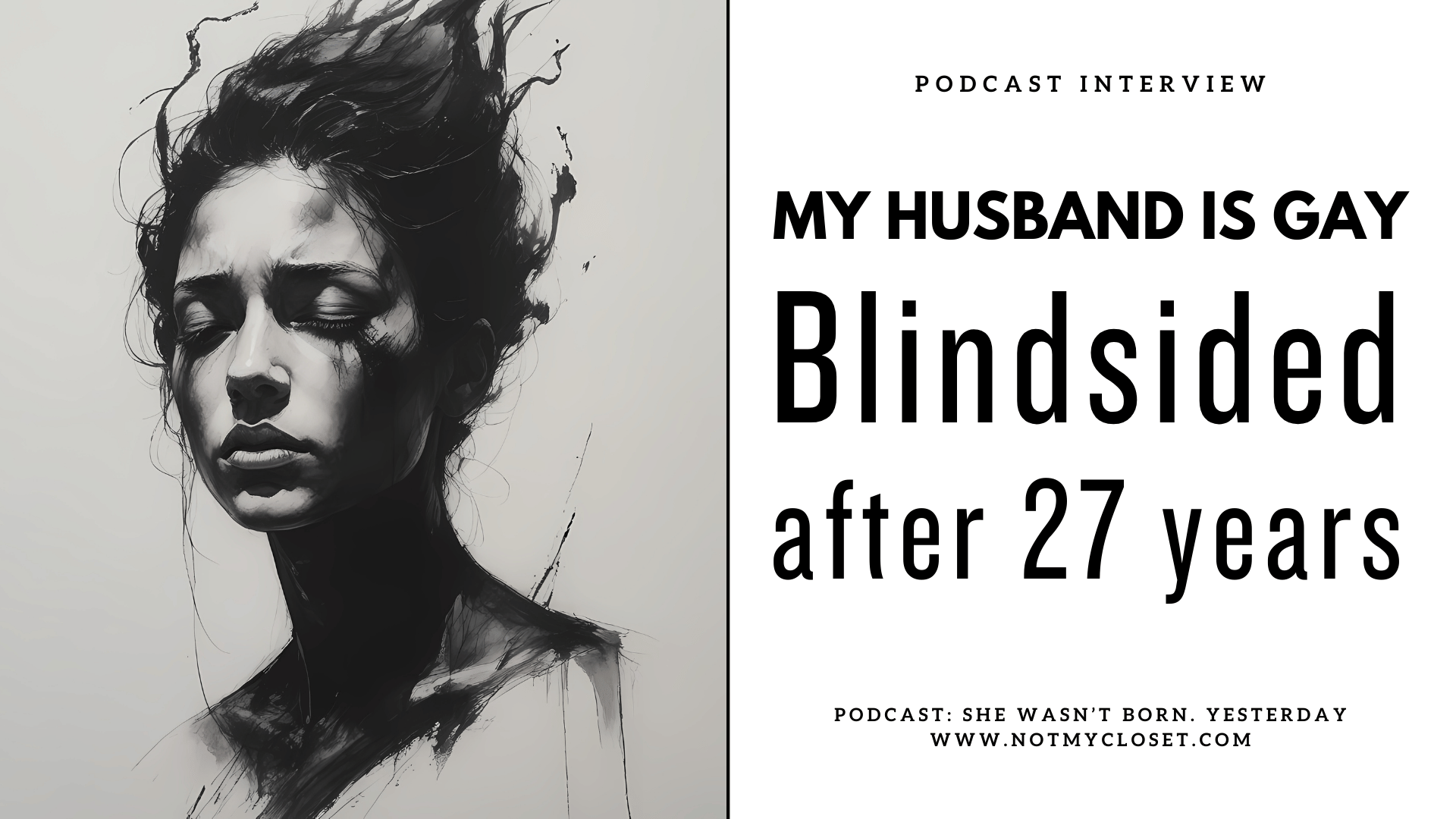
Were you blindsided by the discovery, after decades of marriage, that your husband is gay? If so, you’re not alone!
Straight‑spouse trauma is a rarely acknowledged, yet devastatingly common form of deceptive sexuality. Recently, fellow straight spouse Donna Hanlon and I joined Janet Evans and Jenni Woodhouse on their She Wasn’t Born Yesterday podcast (Hope 103.2) to speak openly about this experience. Donna bravely shared her personal story of meeting her husband in the church, marrying, and then being blindsided after 27 years by the discovery that her husband was gay and had been having sex with men. Many of you will relate to her story. I contributed from a personal and professional perspective, as someone who has also lived through straight spouse trauma and provides counselling and coaching to straight spouses in Australia and around the world.
Admittedly, I was initially unsure how the nuances of straight‑spouse trauma would be handled, but I was genuinely impressed by Janet and Jenni’s openness, sensitivity, and respect! Their willingness to enter this conversation with curiosity and compassion created a safe space for us to speak honestly about the impact of deception, hidden sexuality, and the quiet devastation that unfolds behind closed doors.
Listen to the podcast interview
You can listen to the full conversation below. It’s an honest, compassionate, and deeply validating look at what so many straight spouses endure, often in silence. As with any interview, there are things I might phrase differently or add to the conversation in hindsight, but I’m genuinely pleased with the depth and honesty we were able to bring to the discussion.
What We Talked About
Here are some of the key themes we explored together in the podcast:
- What it feels like to discover your partner’s hidden sexual orientation after decades of shared intimate life
- Emotional betrayal: how the discovery reframes trust and the entire relationship history
- The psychological and relational fallout of realising your partner isn’t who you thought they were
- The ripple effects on family identity, including the often‑overlooked experiences of children
- The impact of religious trauma on closeted mixed‑orientation marriages in Christian or conservative communities
- How faith‑based environments can complicate both the relationship and the recovery
- What straight spouses need in order to feel safe, grounded, and understood
- Where to seek support when your entire relationship narrative is shattered
- The long, often nonlinear process of rebuilding identity, self‑worth, and meaning after such a discovery
There is so much more we could have addressed, of course. What else would you have liked us to have covered? Feel free to leave a comment below!
Some questions we explored in the podcast interview
The podcast covered a lot of ground, and these were some of the key questions we explored. I’ve included brief answers here for quick reference.
Is it normal not to see any signs your husband is gay before discovery or disclosure?
Yes, it’s quite common. Closeted partners often become highly skilled at hiding or compartmentalising their sexuality, and many women are socialised to make sense of relational confusion by working harder, not by assuming deception. Hidden sexuality and relational adaptation can mask the signs until the truth comes out.
Is infidelity with a same‑sex partner more traumatic than infidelity with another woman?
Many women describe it as a different, and often deeper, kind of hurt. An affair with another woman is usually experienced as a painful betrayal of the present, whereas discovering same‑sex infidelity or a hidden gay identity can reframe the entire history of the marriage, not just the affair itself.
Does this happen to men, too? Do husbands discover their wives are gay after years of marriage?
Yes, it happens to men as well. Women can experience shifts in identity or attraction across the lifespan, and when those changes are hidden rather than discussed openly, the impact on husbands can be deeply painful and destabilising.
How often do mixed‑orientation marriages stay together when one partner has concealed their sexuality?
Staying together is less common when sexuality has been concealed, because the secrecy, confusion, and emotional fallout often undermine trust at a foundational level. Relationships based on mutual awareness and transparency have a very different trajectory from those built around hidden identity.
How does discovering a parent is gay affect the children?
Children can adapt well when supported, but they often feel torn between each parent’s emotional reality. They may accept the newly out parent’s identity while struggling to understand the straight parent’s pain. Or they might also feel betrayed by the coming-out parent and protective of the straight parent. Stability, clear communication, and emotional attunement are what make the biggest difference.
What kinds of support help straight spouses during this crisis?
The most helpful support is trauma‑informed, validating, and centred on the straight spouse’s experience, rather than focusing on how hard it must have been for the closeted partner. Therapy, support groups, and long-lasting empathy from others all help women feel grounded and understood as they process the shock and recover from the betrayal trauma and deception.
I am here to help you
If this podcast feels close to home, please know you’re not alone, and support is available if you need a safe place to process what’s happened and navigate your next steps. I offer counselling and coaching for straight spouses and partners of trans people here in Melbourne, across Australia, and globally via online sessions. I also occasionally work with couples who are trying to understand the future of their relationship and decide whether to stay together or separate.
In the podcast, I spoke about my primary focus being on the straight spouse, which is true; however, in some situations, I can provide counselling or coaching for adult children, as long as it doesn’t limit the straight parent’s access to care, or create a conflict of roles.
Whether you’re in the initial crisis phase or further along but feeling stuck, specialised straight‑spouse therapy or coaching can help you feel grounded, supported, and able to move forward.
You don’t have to navigate this alone.


0 Comments