
Your marriage imploded when you discovered the truth about your partner’s sexuality or gender identity. The shocking news that your husband is gay, your wife is lesbian, or your partner is transgender has obliterated everything you thought you knew about your relationship. About your life! You’re reeling, trying to find your feet after having the rugged ripped out from underneath you. Or, perhaps all the past confusion suddenly makes sense, and you now understand the harsh reality of things that were previously confusing and troubling. To make things worse, your partner seems so much further “ahead”. How can they be so ready to move on? How can they be so nonchalant about something so huge?
Your journeys are out of sync
The difference is because of mismatched timelines. You’re in completely different stages of the recovery journey. The reality is, your partner had years – probably decades – to process their thoughts and feelings about their hidden sexuality or gender identity. Your processing started at discovery. It’s no wonder you feel like you’ve been left behind. It can cause all sorts of stress in the relationship dynamic, as you grapple with seeing them leap into the next chapter while you’re still licking your wounds.
Perhaps they married you hoping that their same-sex attraction would magically disappear (which it clearly didn’t!). Or their sexuality/gender was so deeply suppressed they were only partially aware of it. Either way, they had a lot more information a lot earlier than you did. And here you are, playing catch-up in a game you didn’t sign up for and don’t want.
What you’re experiencing looks something like this:
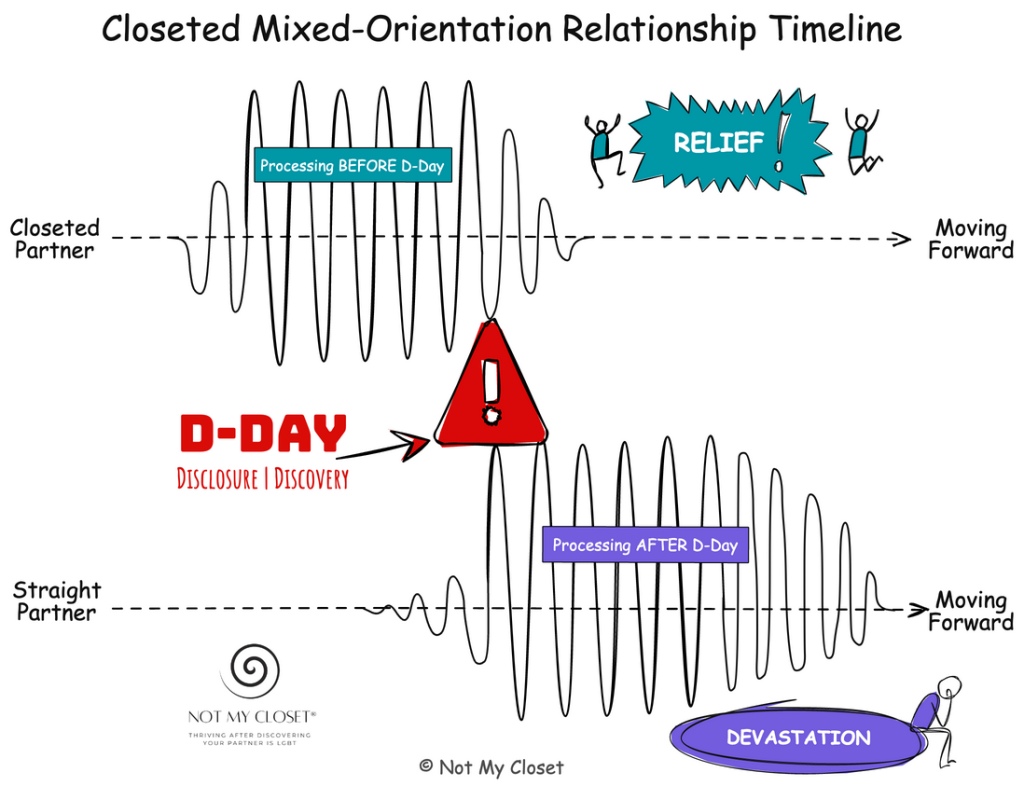
While your partner was navigating the complexities of their secret-keeping with the privilege of insider-knowledge, you were in the dark. You may have been completely unaware, or trying to make sense of things that seemed off. Either way, you didn’t have the information then that you have now.
Now is not the time for comparisons; it’s not a race, even though it can seem that way when you’re “trailing behind”. Now is the time for self-compassion. Whatever you’re feeling at this point in your journey is completely natural and understandable, given what you’re going through.
Basically, your partner got a headstart on healing.
Heal at your own pace
Be kind to yourself and – if it’s helpful – make the disparity clear to your partner. This can be especially important if they’re judging or shaming you for “not being over it” yet. You don’t need to beg for their understanding or compassion, but it’s okay to state the reality if you believe that will be helpful.
It’s totally okay to take whatever time you need to process your emotions and come to terms with this unwanted reality. Be patient – your healing will come. There is no required timeline for processing your pain, other than what is normal for you.
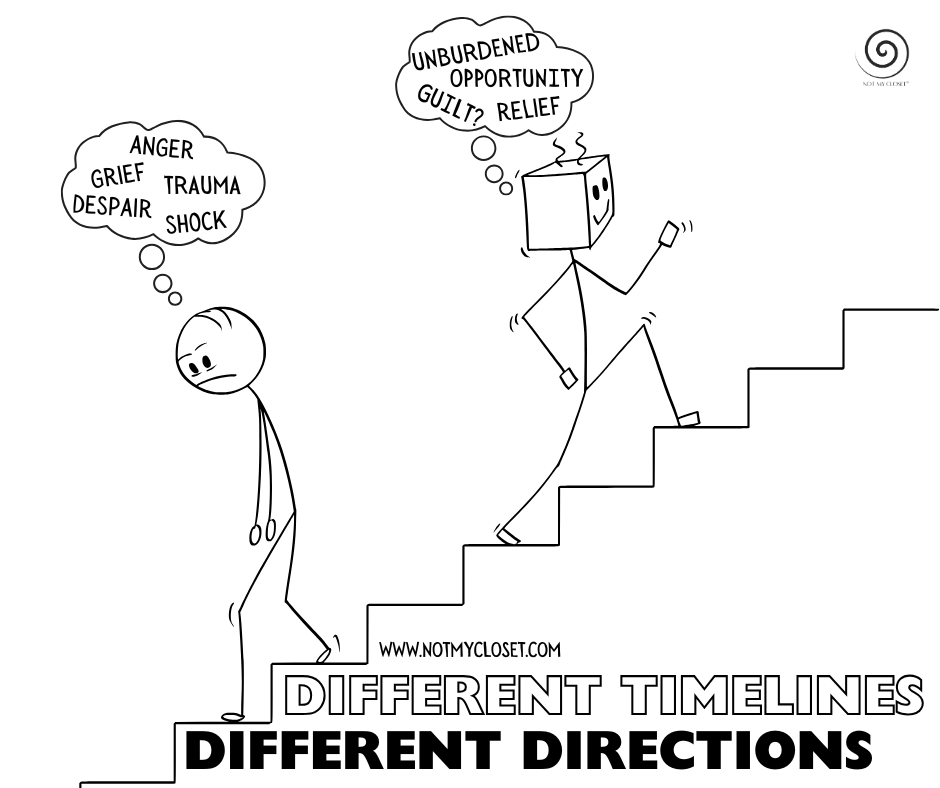
It’s difficult to see your partner seemingly 10 steps “ahead” and ready to move into their next chapter, while you’re still in a state of distress. They’re making up for what feels like lost time, and they can feel a sense of entitlement to do so. This often leads to them being impatient with your suffering. Reminders of your pain or sadness may elicit feelings of guilt in them, which is unpleasant and can cause resentment. This is for your partner to process, however; it’s a natural consequence of what’s happened.
You’re heading in different directions now.
Look after yourself while playing ‘catch-up’
Your partner has had a head-start on putting things in place to move forward. They may be in a calmer emotional state, whereas you’re in a state of shock. It’s difficult to make logical, well-reasoned, rational decisions when you’re feeling emotionally distressed or fragile. And yet, decisions must be made. The priority early on is safety and stabilisation.
You need validation, empathy, encouragement, and hope. Unfortunately, your partner is unlikely to be the person to give them to you. You need and deserve support to help you process your emotions and make sense of things. It’s sadly all too common for the coming-out partner to become self-absorbed as they make up for lost time and finally reach for the freedom they want. You also need to prioritise meeting your needs.
Many straight spouses (particularly women) have spent decades walking on eggshells, trying not to upset their partner because they know they’re unhappy but they don’t know why. If you’ve had this background in your relationship, it’s important to move from a “we” mindset to a “me” mindset, giving yourself permission to do what is right for you. If you’re prioritising your partner’s needs, while they’re prioritising their own needs, who is prioritising yours? It’s not selfish to care for yourself.
Ask yourself these questions:
Wherever you’re at in your healing journey, I hope you can be kind to yourself and focus on YOUR next step, whatever it is, and no matter how small. Please reach out if you’d like help to manage your mismatched timeline situation. I’ve been there, and I work with people going through this every day. I’m here to help.





It is so affirming to read the words that so effectively articulate the experiences I’m moving through. Thank you.
I forgot to say – this infographic is superb. Thanks for educating us therapists also!
Strait spouses are so lucky to have your 100% support Karen, as is the LGBTQI+ community to have you to refer their partners to and to help them come out in a gentle, caring manner.
Karen, we are so blessed to have your insight and understanding. Thank you!
Oh Karen we so need resources like yours in Canada. The only North American resource for straight spouses is Our Path and they stopped doing podcasts earlier this year. The only monthly support groups available are in the USA. Your posts have been an invaluable resource. A place where our pain is acknowledged, understood, and articulated so eloquently. Thank you for providing a rare space on the web where we feel supported and receive such helpful advice We need you Karen!
It’s a pleasure to provide the support and validation. I’m hoping to write a lot more! And have so many other things I want to do to help straight spouses. Stayed tuned to the newsletters – online groups are coming!