
The Impact of a Secret Sexual Basement on the Straight Spouse Upstairs
If you’ve discovered your partner’s hidden sexual orientation or gender identity, you might struggle to make sense of what’s happened. You might wonder why it hurts the way it does.
This is where the Minwalla Model comes in. Developed by Dr. Omar Minwalla, this framework doesn’t treat what happened as an addiction or a behavioural slip. It centres your experience as the victim-survivor. And it names how chronic deception and manipulation of reality create a distinct kind of trauma. When a partner’s concealed sexual orientation or gender identity is involved, the betrayal isn’t just behavioural; it’s deeply tied to identity, truth, and the reality of the relationship itself.
I trained extensively in intimate partner betrayal trauma recovery before training in the Minwalla Model, to help develop my understanding of straight spouse trauma. I’ve seen firsthand how much further this framework goes for straight spouses navigating this specific kind of harm. Betrayal trauma theory primarily centres on the impact of compulsive sexual behaviours. While that can be a factor with closeted partners, straight spouse trauma is far more complex than betrayal trauma alone can capture.
Discovering the Minwalla Model in 2023 changed how I understand and work with this kind of trauma. In this post, I want to focus on one key concept within the model: Secret Sexual Basements. We will use this metaphor to make sense of the hidden realities many straight spouses find themselves confronting.
First, what does a healthy relationship look like?
Healthy relationships are built on honesty, openness, and mutual respect. Therapists John and Julie Gottman spent decades researching what makes relationships work. They represent it with the metaphor of a house: a Sound Relationship House. Picture it like this: the foundation is trust and commitment, with load-bearing walls holding everything else up. Above the foundation, you build layer by layer. You get to know each other’s inner world, sharing fondness and admiration, turning towards each other instead of away, seeing the best in one another, working through conflict together, and building a life and a sense of meaning together.
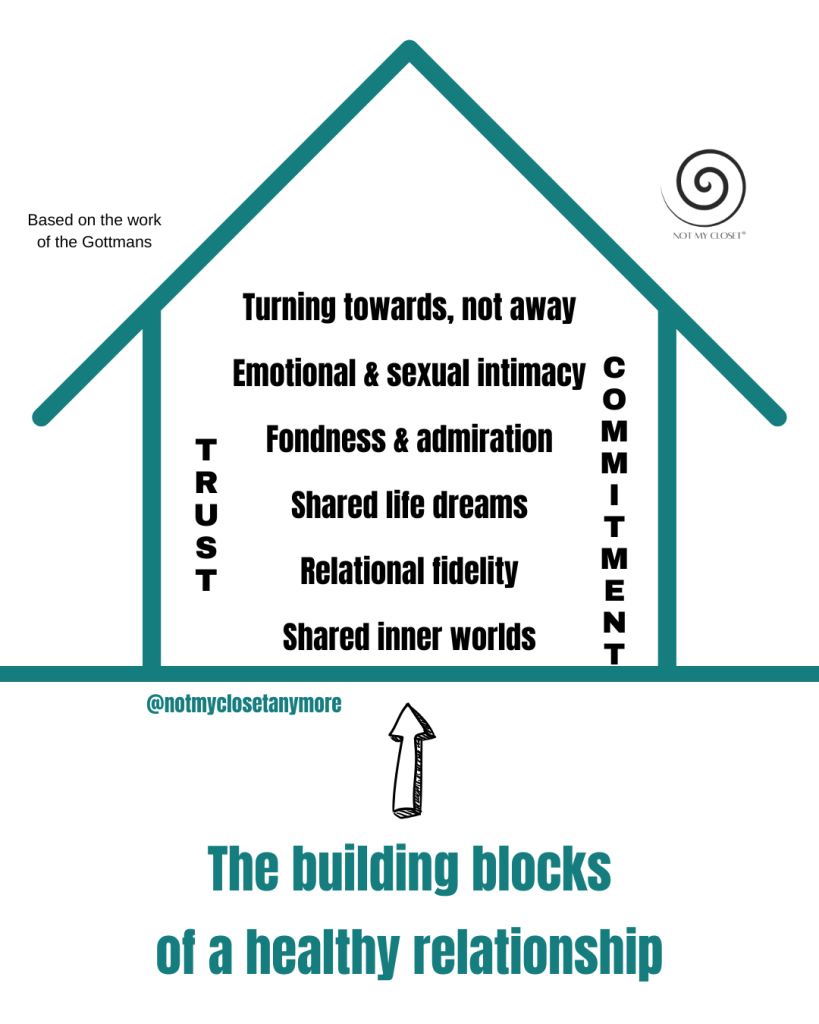
I often use this idea with clients to help them think about whether their relationship has these foundations. Unfortunately, most closeted mixed-orientation relationships don’t.
What gets in the way?
Lies.
Secrets.
Deception.
These things don’t belong in relationships. You probably entered yours trusting that your partner was exactly who they seemed to be. Why would you assume otherwise? Unless you had previously been betrayed, you’d understandably presume your partner was trustworthy. You wouldn’t imagine that they were secretly confused about their gender or sexuality, or – worse – intentionally hiding it. Searching for signs of deception isn’t typically on anyone’s radar!
You dreamed of building a life together, similar to the sound relationship house. Instead, you discovered that your partner had a secret sexual basement. They were hiding the truth about their sexual orientation or gender identity underneath everything you thought you were building together. The structure was never what it seemed. The rug was ripped out from under you, and you were left questioning the whole relationship.
What is a secret sexual basement?
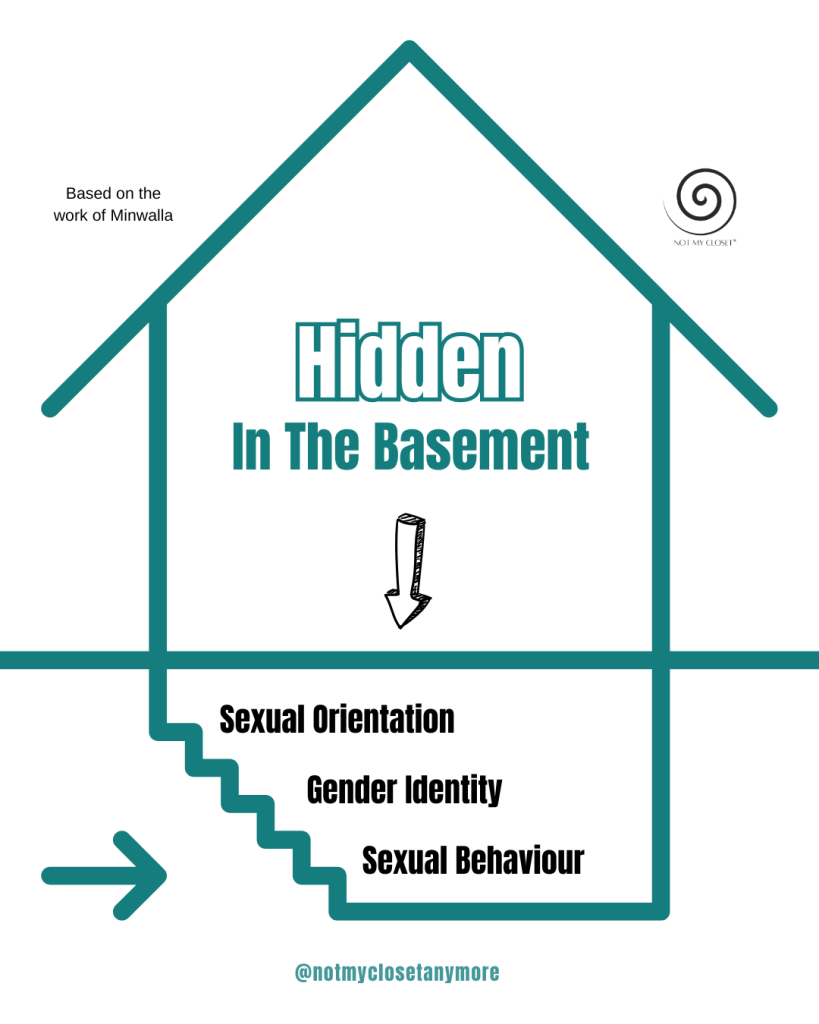
Dr Minwalla uses the metaphor of a Secret Sexual Basement to describe one partner’s hidden, compartmentalised, secret sexual life. It is deliberately kept hidden from the partner (and any children) upstairs. And so, you’ve been living life with a partner you thought you knew so well. You felt closer to your partner than anyone else. you trusted them more than any other. Yet in the end you discovered they were showing you a false self, with an entirely separate life hidden away.
This is betrayal. An attachment rupture. A relationship trauma. And its impacts undermine your sense of safety and stability.
What is Deceptive, Compartmentalised, Sexuality?
Dr Minwalla has a clinical term for the secret sexual basement: Deceptive, Compartmentalised, Sexual-Relational Reality, or DCSR. It’s a mouthful, but each part matters.
It’s deceptive. Important truth is hidden from the partner, truth they have a right to know.
It’s compartmentalised. The basement is kept walled off from the partner upstairs. Keeping it that way takes ongoing effort, which Minwalla names integrity abuse. This impacts every part of life, not just the secret itself.
And it’s a sexual-relational reality, not a one-off secret like hiding a job loss out of shame. Sexual deception reaches into the relationship’s core. Over time, it can quietly erode the unsuspecting partner’s own sense of their sexual self-worth. They often blame themselves for problems that were never theirs to carry. DCSR reshapes how someone experiences reality itself.
Put together, these three parts paint a picture: the secret-keeper hides a significant part of their inner world from their “intimate” partner. True intimacy isn’t possible where sexual deception is present. It isn’t only that something is hidden, but what that something is, that damages the intimate relationship.
What does a secret sexual basement do to relationships?
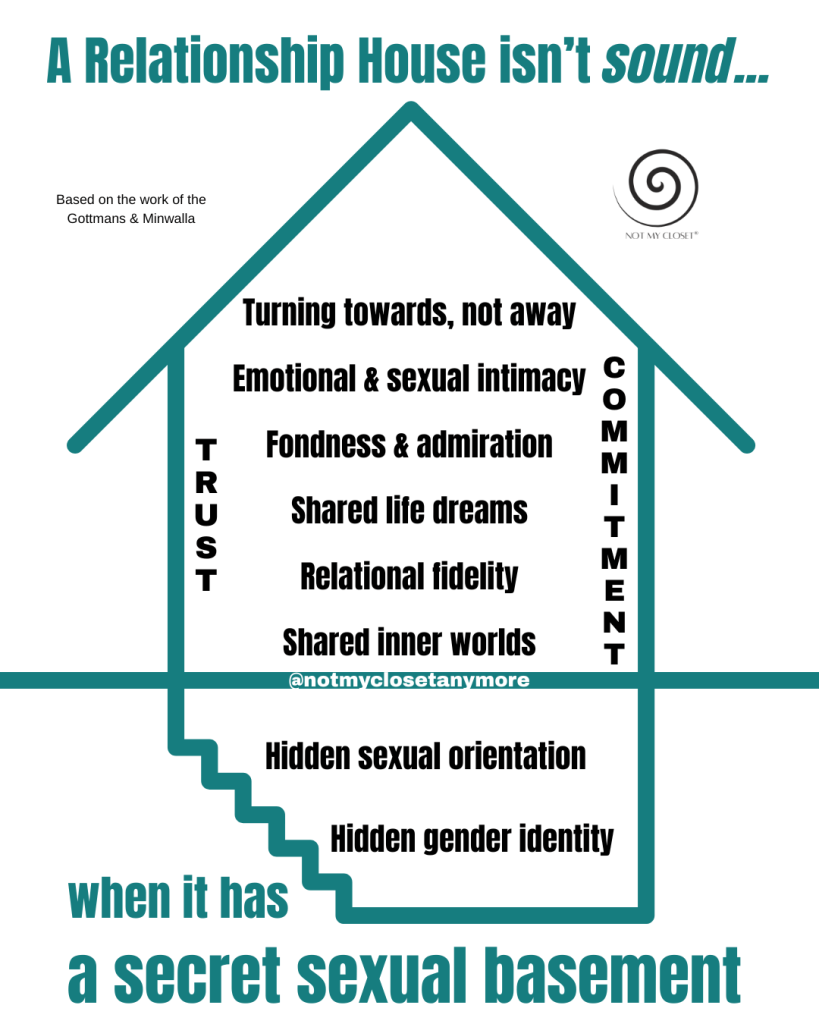
A secret basement makes everything upstairs unstable, fragile, and at risk of collapsing without warning. Houses are only as stable as their foundations, and relationships are no different. When one partner withholds something as significant as their sexual orientation or gender identity, most of what makes a relationship sound is absent. It looks like a solid house. But underneath, the foundation was never what it seemed.
Here’s what it looks like when you put the two ideas together:
Are all basements bad?
A person’s sexuality and gender identity are at the centre of who they are. It’s their core identity. Dr Minwalla calls this the triadic core: the overlapping templates of the three most sensitive tissues in the human psyche:
- Sexuality and the sexual self
- Gender and gender esteem
- Biology and the physical body
Because this part of self is so sensitive, it’s often not safe, or anyone’s business, to share publicly. But there’s a difference between what’s safe to keep private from the world, and what’s okay to keep hidden from the person you’ve built a life with. Once there’s a partner in the “house” upstairs, sexual orientation and gender identity are no longer simply “private information.” They become “they-have-a-right-to-know” information. (More on the difference between private and secret in a future post.)
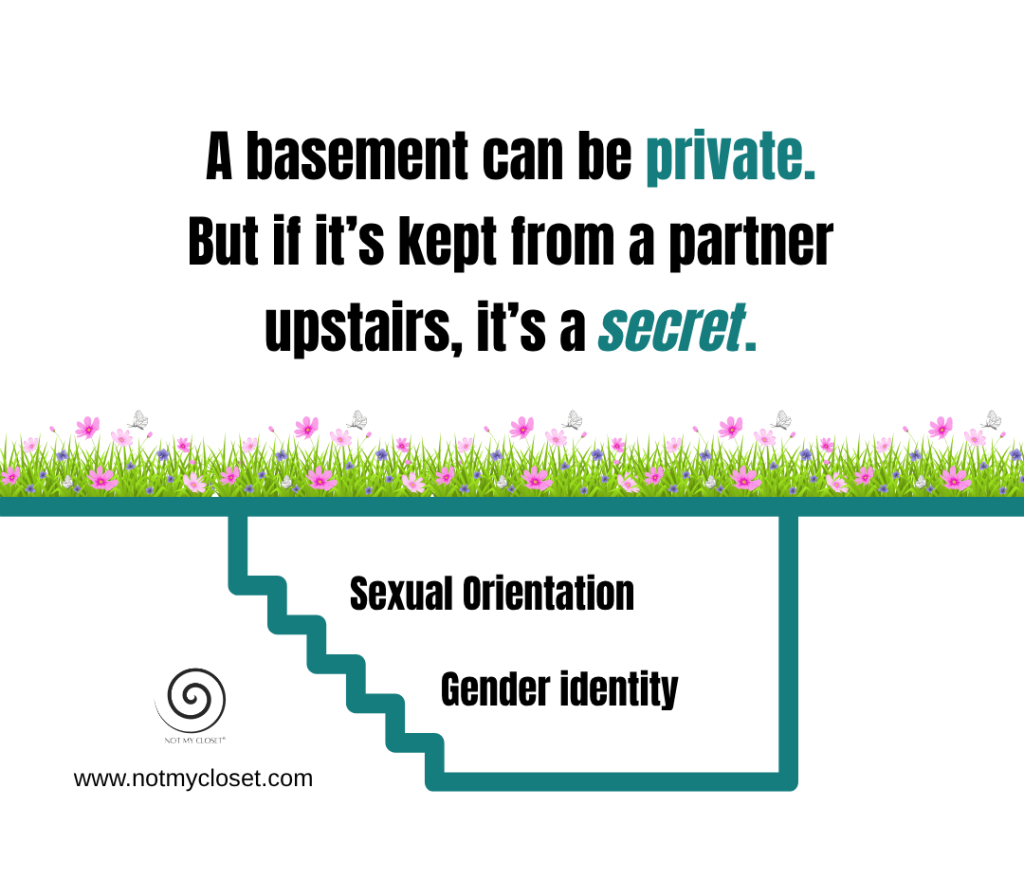
Straight spouse trauma: living on top of a secret sexual basement
Straight spouse trauma runs deep and lasts so long because your wounding is at the level of your triadic core. Dr Minwalla has identified 22 traumatic injuries and symptoms of deceptive sexuality trauma experienced by victim-survivors. I think there are a few extra injuries specific to straight spouse trauma.
Straight spouse trauma is a retrospective, traumatic grief that cancels the entire history you thought you’d lived. In an attempt to make sense of things post-discovery, you may find yourself obsessively hunting for more information. It’s difficult to begin healing when everything feels so confusing and unstable. Your first job is to find a sense of safety and stabilisation. With time and the right help, you can feel solid ground under your feet again, instead of living on top of a shaky, secret basement.
Do you need support?
Email support: If this resonates with you, you may like to sign up for my newsletter, “Letters From a Straight Spouse“.
Therapy and coaching: I completed my certification in the Minwalla Model in December 2024. Since that time, I’ve been integrating it into my practice, both in Australia and internationally. This post marks the beginning of sharing that work here. If you’ve experienced deceptive sexuality trauma, you’re welcome to book a complimentary connection call. We can talk about whether therapy or coaching with me is right for you.
Consultation and clinical supervision: If you’re a therapist or coach, you’re welcome to check out my supervision and consultation services or refer a client.
Shining a light on your story
If you’ve discovered that you’ve been living on top of a secret sexual basement, you might like to leave a comment below. Only if it feels safe and healing for you to do so. This can be a helpful way to begin reclaiming your own story. You can use a pseudonym here, which is often safer than commenting under your own profile on my Facebook page. You might like to respond to one of these questions:
- Looking back, can you see that the basement was affecting you even before discovery?
- How has this experience affected you?
- Did you discover the truth, or did they come clean?
- Where are you in your healing process now?



After 29 years, my husband butt-dialed me while entertaining a man in his hotel room. This happened only a month ago. It was quite literally only a few days after we came home from our anniversary trip.
A month later, I am trying to rebuild my life. He says he is bisexual, and wants to stay with me, but like the article said, I am struggling with the identity of our marriage.
I’ve told a very small amount of people in my life, and they are supportive, but I have been isolating myself a lot.
I’d like to share my story as an encouragement to LGBTQIA+ people that sharing your whole self from the get-go can be a positive experience. I do however appreciate that every situation is different.
I’m 100% straight, in my 50s, divorced for many years, and 3 years ago met a wonderful man of a similar age. Very early on (after our third date, I think) he told me that he has what he calls “bisexual tendencies”, as in strong desires to have sex with men, but it’s a sex only thing; when it comes to a life partner he’s only interested in women. He wanted to put that on the table upfront because he didn’t want to live a lie about who he was, and said that he understood if it was a dealbreaker for me.
This was of course quite a surprise to me but ultimately I felt even closer to him because he felt safe to reveal something about himself to me that he’s told no-one else about.
We are very happy and have a wonderful intimate life. With this information on board I still chose to continue the relationship with my eyes open and I love all of who he is.
Such an excellent visual representation of the sexual betrayal trauma that impacted me. Karen used this during a counselling session with my gay ex and it was incredibly powerful and educational for him as well, he realised that his secret basement had permeated every fibre of our 30 year marriage.
Such valuable insights into a reality and a dynamic that affects so many who suffer alone. Love your work, Karen
Thank you for this. I feel seen and understood. It’s comforting to know what I’m feeling is expected and I’m not just weak.
Such important work you are doing Karen.